Kathryn Scheckel – Class of 2007
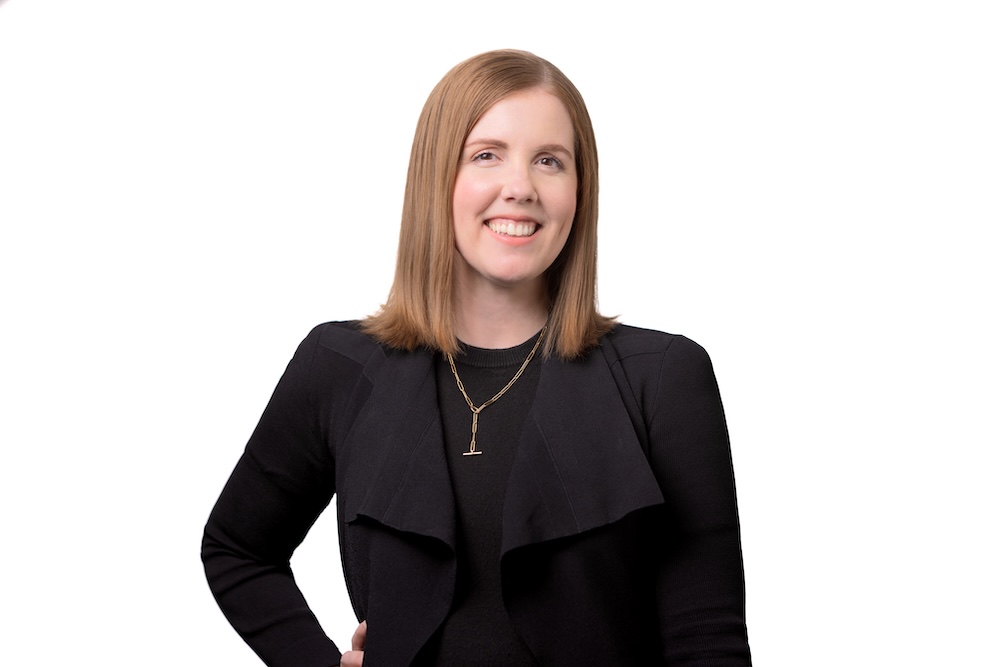
Will you share a little about your current role and what excites you most about your work?
I serve as an executive in residence and University Presidential Fellow at Arizona State University, where I focus on resource generation and growth strategy across the institution working with President Michael Crow and his leadership team. Much of my work sits at the intersection of strategy, innovation, and venture building — thinking about how a large public university can expand access, drive new revenue models, and remain academically excellent while adapting to profound change in higher education.
Before returning to ASU, I led the Global Ventures platform at Hines, a privately held global commercial real estate developer and investor, where I worked on venture building, venture investing, and commercial partnerships. Prior to that, I was at McKinsey & Company in New York, and earlier in my career I worked on strategy and partnerships at ASU with President Crow and our research leadership, including former Research Officer Sethuraman Panchanathan. Strategy and operations have been the through line across each chapter.
My path hasn’t been linear, and I hope it never is. I spent seven formative years in New York, collaborating across industries and learning from people with very different lenses. What excites me most now is applying that cross-sector perspective to education at a moment when reinvention is not optional — it’s necessary.
How did being a Flinn Scholar shape your academic and/or career path?
The Flinn Scholarship truly set my career in motion. It gave me the freedom to explore broadly without the burden of debt, and that freedom shaped how I approached my education. I leaned deeply into ASU — academically, socially, and entrepreneurially.
Through the ASU Edson Student Entrepreneurship Initiative, I launched my first startup and began exploring venture building long before I knew that term would define part of my career. I added piano as a major (in addition to molecular biology) because I could. I studied across disciplines because I was encouraged to. I traveled, built lifelong friendships, and found extraordinary mentors, including (former director) Michael Cochise Young, who helped me see possibility at scale.
Flinn didn’t just support my education; it expanded my imagination about what was possible.
How do you stay connected with the Flinn community today?
I try to stay engaged in both formal and informal ways. I attend events when I can and make time for coffee conversations with Foundation and program leadership. I stay connected with fellow Scholars across graduating classes, and I enjoy meeting prospective students considering ASU.
I was also fortunate while at ASU to be selected as a 2014 Flinn-Brown Fellow. This experience allowed me to engage again with both the Flinn Foundation and Thomas R. Brown Foundations and develop my civic leadership capabilities alongside completing my Master’s of Public Policy from ASU in 2016. This experience helped me better understand more deeply the policy, civic leadership and public service pathways available to me in the state of Arizona and more broadly, creating another visibility of how the Flinn Foundation impacts Scholars at many different phases of their life.
Flinn is a lifelong community, and I feel a responsibility to pay forward the mentorship and support I received.
Looking back, what’s one lesson from your time as a Flinn Scholar that has stayed with you?
There are many pathways to where you want to go, and very few are linear.
As a Scholar, it sometimes felt like everything hinged on academic performance within a defined ecosystem. Over time, I realized that being a well-rounded citizen — curious, resilient, collaborative, and grounded — is just as important. Taking care of your health and investing in relationships matter. So does embracing detours.
The through line is growth, not perfection.
What impact do you hope to make in your field or community in the coming years?
I hope to help reimagine how higher education expands access and affordability while remaining financially sustainable. Public universities play an essential role in economic mobility and innovation, but the traditional models are under strain.
If I can contribute to building new models — whether through partnerships, alternative credentials, venture creation, or global collaboration — that allow more learners to thrive, I’ll consider that meaningful progress.
What’s one unexpected skill you picked up during college that you still use today?
Piano — a skill I deepened greatly in college.
At the time, it felt like an artistic counterbalance to my analytical coursework, along with the ability to study with world class artist Caio Pagano at ASU’s School of Music. Today, I see how much it shaped me. Performing teaches discipline, preparation, and comfort with being evaluated in real time. It also builds pattern recognition and the ability to hold complexity — multiple lines of music moving simultaneously.
Leadership often feels similar: structure and improvisation, precision and creativity, all at once.
What’s the most surprising way your Flinn experience has popped up in your life post-college?
The network. Time and again, I’ll walk into a room, whether in Arizona, New York, or elsewhere, and discover a fellow Scholar connected to the work. There’s an immediate trust and shared language around ambition, service, and intellectual curiosity.
That sense of shared foundation has opened doors and deepened collaborations in ways I couldn’t have anticipated as an undergraduate.
What’s something you’re currently learning, exploring, or curious about?
I’m currently pursuing a Doctorate of Professional Practice in Global Leadership and Management through ASU’s Thunderbird, and I expect to graduate in 2028. My doctorate research likely will focus on failure, specifically, how organizations and systems can learn from failure more analytically and proactively.
We study failure rigorously in fields like aviation and engineering. I’m curious how we might apply similar systematic approaches to organizational leadership, public institutions, and even global governance. What would it look like to normalize structured learning from failure at scale?
What book, podcast, or piece of media has changed how you think in the last year?
I’ve been immersing myself again in the history and economics of higher education. Works examining the structure, incentives, and financing of universities have sharpened my thinking about sustainability and mission alignment.
Revisiting this field through both an academic and practitioner lens has reminded me how deeply policy, economics, and leadership decisions shape opportunity for millions of students.
What advice would you give your 18-year-old self?
Be ambitious, but define ambition broadly. Build things. Take risks earlier. Protect your health. Invest in friendships and your family. And remember that your career is a portfolio, not a ladder.