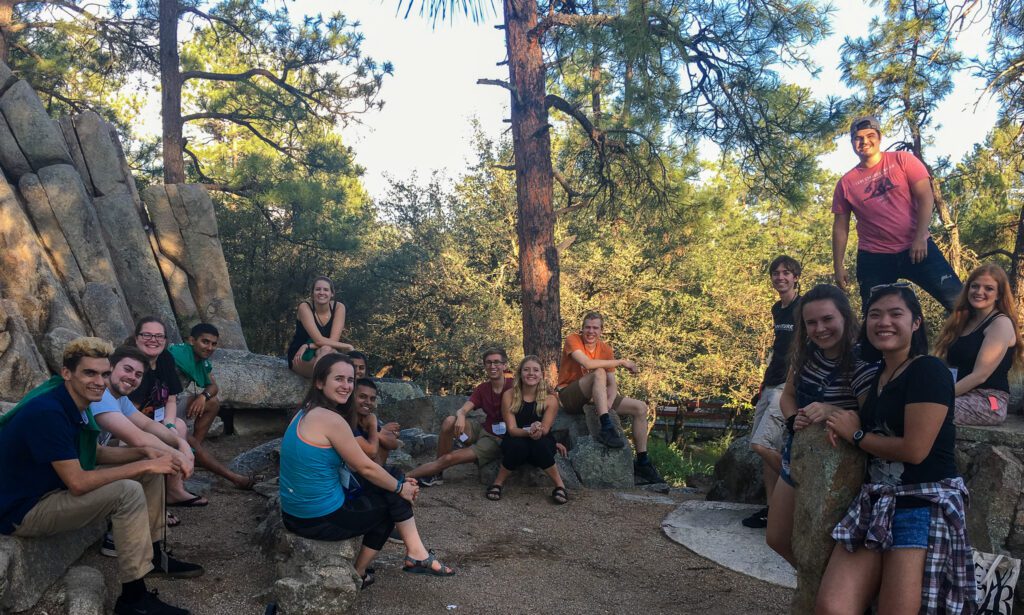
Have questions about the Flinn Scholarship? You’re not alone. This FAQ page is here to help you navigate the application process and give you a clearer picture of the opportunities and expectations that come with being a Flinn Scholar. You are welcome to contact the Flinn Scholars Program with any additional questions.
Applicant FAQ
- Aug. 25, 2026: Application opens.
- Oct. 13, 2026: Application deadline.
- Oct. 27, 2026: Recommendations/counselor report deadline.
- January 2027: Semifinalist interviews (virtual).
- March 2027: Finalist interviews at Flinn Foundation.
- April 2027: Class of 2027 announced.
- May 2027: Recognition Luncheon.
Competition is much more rigorous for the Flinn Scholarship than for admission to even the most selective colleges and universities; we typically receive more than 1,100 applications each year. Our reviewers examine applicants’ academic achievement, leadership and involvement, service to the community, ability to communicate, and personal qualities. We encourage you to devote yourself to your studies, your extracurricular interests, and service to your community. Start your application early and communicate often with the individuals who will write your recommendations.
We understand that many students from small or college-prep schools may not be in the top 5% of their classes, despite high academic achievement. We still encourage you to apply.
Your counselor will be able to indicate that your high school doesn’t rank on their counselor report.
Yes. The counselor report is typically provided by the parent who took primary responsibility for the student’s education. That report must provide information about the curriculum and home-schooling approach. The academic recommendation may be from someone who taught the student at an accredited institution: high school, community college, or university, or from the parent who took primary responsibility for the student’s education. The leadership/service recommendation may come from a teacher, professor, or community member, but may not come from a relative or family member. Receiving independent assessment of the student’s academic and social performance in a group context can be valuable to our reviewers.
Yes. Flinn Scholarship applicants must self-report at least one ACT or SAT score on the application. There is a minimum test score of 26 on the ACT or 1230 on the SAT.
Official test score reports are required from those who advance in the process.
Yes. Taking such courses shows evidence of pursuing a challenging academic program, one of the qualities we look for in Flinn Scholars. International Baccalaureate and Cambridge coursework also count towards a rigorous academic record. Flinn Scholarship applicants must self-report their AP, IB, and Cambridge test score(s) on the application. College coursework not listed on your high school transcript can be entered on the application as well.
There’s no “right” answer when it comes to your academic or career goals. We’re interested in learning what fields spark your curiosity, what you might want to study in college, and what kind of future you imagine for yourself. Whether your plans are well-defined or still evolving, your answers help us get to know you better.
The academic recommendation must be from a high-school teacher who has given you a grade (with the sole exception being for home-schooled applicants). The leadership/service recommendation can be from a teacher, counselor, coach, employer, or community member. Recommendations from relatives or family members are not accepted.
No.
Teachers who know you well will be able to speak more convincingly and in much more detail about your various strengths, experiences, and potential. There is no preference for teachers from specific subject areas.
As part of your application, you will provide the names and email addresses of your two recommenders and counselor. They will each receive an email with instructions. Your counselor will complete a school report, not a recommendation. There is no recommendation as part of the counselor report. Please notify your counselor and recommenders to expect email correspondence related to the Flinn Scholarship.
Yes, with some important distinctions:
Outside Scholarships (from private organizations, nonprofits, etc.) can be accepted at any time.
ASU, NAU, and U of A scholarships have specific rules to avoid competing offers (“bidding wars”). After you’re named a Flinn Scholarship Finalist, any new university merit offers must be conditional—only valid if you are not selected as a Flinn Scholar Awardee.
Exception: You may accept National Merit scholarships offered by an Arizona university. These offers are made before Flinn decisions are announced and are honored regardless of Flinn Scholar selection.
Need-based aid is determined separately through the FAFSA. Eligible students may receive need-based aid. All financial aid is coordinated by the university in accordance with federal regulations and institutional policies.
Students who are applying through a binding Early Decision process to an out-of-state college or university may apply to the Flinn Scholarship. Early-decision applicants commit to attend a particular institution if accepted; such students would not be able to accept the Flinn Scholarship if offered. Applicants who are applying early decision commit to updating us on their status in December.
We encourage students to apply early to all three Arizona universities, as applying early may increase your chances of honors-college admission, earning university-based scholarships besides the Flinn Scholarship, and preferred on-campus housing. Arizona’s universities do not offer binding Early Decision options.
Applicants can check the status of their required tasks and recommendations through the application portal. If all required pieces of the application are completed by the deadline, applicants will receive an email notifying them of the decision timeline. All application status updates are sent via email with the exception of scholarship offers in March.
If named one of about 75 Semifinalists, your name and high school will be made public in a Flinn Foundation announcement, and you will be invited to participate in a virtual interview. If selected as one of about 35 Finalists, you will be invited to special visits at all three Arizona public universities before your in-person interview with the Selection Committee. The three universities have agreed to award Semifinalists a scholarship (or a combination of scholarships) that covers the cost of base tuition, renewable up to a total of eight consecutive semesters.
We do not provide information regarding an individual’s performance to applicants, their families, or their teachers and counselors, during or after our selection process. All materials applicants submit, and all material generated during the review process (i.e., readers’ and interviewers’ notes) remain confidential, as do students’ recommendations.
A student must complete one academic year in the Scholars Program, immediately following high-school graduation, before they are eligible for a leave of absence.
The Flinn Scholars community, a critical element of the program, develops around shared experiences from the time of selection, through the undergraduate years, and beyond.
Beyond the first academic year, Flinn Scholars may take a leave of absence from the Scholarship for up to four semesters, or two academic years. The semesters of leave may, but need not, be taken consecutively.
Scholars submit an annual narrative about their coursework, on- and off-campus activities, career plans, and overall college experience. They must maintain a 3.2 cumulative grade-point average and participate in at least two Foundation-related activities each academic year. More details can be found on our Benefits and Expectations page.
Yes. The international summer seminar is attended by every Scholar after their freshman year. The Flinn Scholars summer seminar complements and broadens a Scholar’s field of study, provides experiences beyond degree programs, and provides opportunity to experience the culture and history of other locales and people. In addition, Scholars choose at least one other study abroad experience.
(The Flinn Scholars Program will consider a compelling circumstance that would prevent the student from participating.)
The Flinn Scholars Program values the exchange of ideas, the consideration of diverse perspectives, and meaningful engagement with complex issues. A hallmark of the program is fostering thoughtful dialogue—where Scholars are encouraged to bring their unique viewpoints while also embracing respect, civility, and the opportunity to build relationships across different perspectives. Scholars are not expected to abandon their beliefs, but they are challenged to broaden their understanding by seeing issues through others’ eyes. There is no single “Flinn Scholars position” on any issue, and while Scholars are welcome to share their experiences and perspectives in public and private forums, they should take care to clarify that they are speaking as individuals, not on behalf of the program or the entire Flinn Scholars community.