By Kerry Fehr-Snyder
Special to the Flinn Foundation
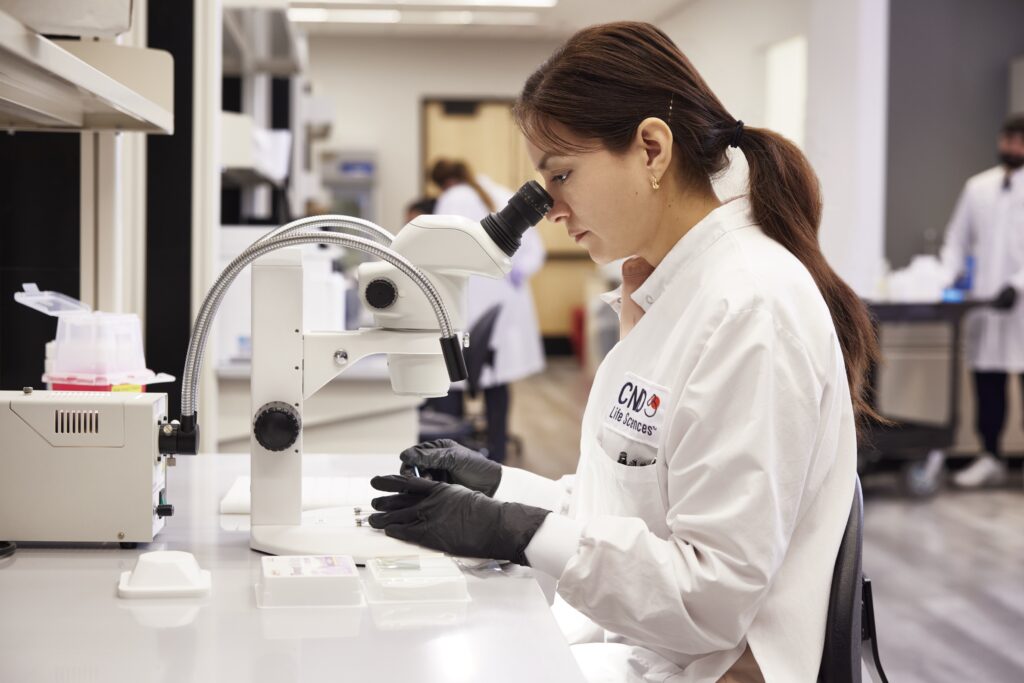
A Scottsdale-based bioscience company has developed a test that relies on skin-deep anomalies to detect neurological disorders in the brain including Parkinson’s disease and Lewy body dementia.
CND Life Sciences’ Syn-One Test is already commercially available as a laboratory developed test (LDT), and the company is considering seeking FDA approval for Syn-One to be the first cleared diagnostic tool to detect these neurological conditions in this way. About 1 million Americans live with Parkinson’s. Another 1.5 million Americans have been diagnosed with Lewy body dementia, the second most prevalent type of dementia, but one that is often undiagnosed.
The National Institutes of Health named the test one of its “Top Promising Medical Findings for 2024” and awarded the company a $3 million grant in 2025.
The Syn-One Test identifies unusual nerve fibers associated with the diseases and related disorders including multiple system atrophy, pure autonomic failure and REM sleep behavior disorder.
CND Life Sciences CEO Richard Morello said the company’s founders discovered “we may be able to use skin as a window into what’s happening in the brain.”
It also gives neurologists a higher degree of specificity about the various diseases and allows for a more accurate diagnosis, he said.
The genesis for studying abnormal proteins in the epidermis came about 15 years ago from Dr. Todd Levine, a neurologist with longtime Arizona ties who was working with two other neurologists at Harvard University. Together, they studied how abnormal proteins can be the hallmark of some of these diseases that can start peripherally, Morello said.
Levine founded CND Life Sciences in 2017 and is now its chief medical officer. He’s also director of preventative neurology at HonorHealth.
The Syn-One Test works by taking three small skin biopsies from a patient. The samples are taken from the back of the neck, above the knee and above the ankle.
It takes about three weeks to get results to a neurologist, who will then meet with the patient.
CND is working with pharmaceutical companies to determine if “we see signals in the skin based on using the Syn-One Test that may tell us this drug may be hitting the target versus another drug that we don’t see it hitting the target,” Morello said.
“So that’s the real future,” he added.
The company plans to seek FDA approval in the next few years.
CND is privately owned and employs more than 100 people. The company is among Arizona’s growing bioscience sector and won a 2023 Arizona Bioindustry Association Fast Lane Award during Arizona Bioscience Week.
The Flinn Foundation, which has managed Arizona’s Bioscience Roadmap since it was introduced nearly a quarter-century ago, has highlighted the company as a key contributor to the state’s growing bioscience ecosystem, specifically in the areas of neurodiagnostics and precision medicine. A goal of Arizona’s Bioscience Roadmap, “accelerate research into impact,” encourages rapid commercialization of research and innovation happening the state.
The Flinn Foundation is a Phoenix-based privately endowed philanthropic grantmaking organization established in 1965 by Dr. Robert S. and Irene P. Flinn that awards grants and operates programs in four areas: the biosciences, the Flinn Scholars, arts and culture and the Arizona Center for Civic Leadership.