When asked what’s the single most important thing for Arizona’s three public universities, independent research institutions, and health systems to be doing in the biosciences, Sethuraman Panchanathan, Ph.D., said he was going to list the top three things:
“Partnership, partnership, and partnership.”
It was a recurring theme for Panchanathan — who has returned to Arizona State University after serving as National Science Foundation director — during his conversation with Flinn Foundation President and CEO Tammy McLeod, Ph.D., at the April 8 Progress Report event for Arizona’s Bioscience Roadmap.
“I would strongly encourage all institutions to get to know each other. Partner, partner, partner more and … get away from the silos, which I think is already happening,” he said.
The progress report event also included the announcement of two new milestones for Arizona bioscience: Record-breaking NIH funding and academic R&D expenditures. The new data show:
- Arizona received $397 million in grants from the National Institutes of Health in 2025, a new annual record for the key metric of biomedical research funding — an increase of 14.7% since 2022. In addition, Arizona’s share of national funding in 2025 surpassed its longtime 1% target, finishing at 1.08% of the nation’s funding, 24th among all states.
- Arizona’s academic research and development expenditures in 2024 reached a record-high $855 million, one year after exceeding $800 million for the first time. Arizona’s growth rate of 21.3% in bioscience R&D funding between 2022 and 2024 outpaced the nation.
The event’s second segment was a panel moderated by Christine Mackay, president and CEO of Greater Phoenix Economic Council, featuring Mara Aspinall of Illumina Ventures and ASU; Jacob Busch of TGen; and Nigel Pinto of West Pharmaceutical Services. The panel touched on the state’s workforce and industry’s trajectory, including the growth of the Phoenix Bioscience Core, why a global company would enter Arizona, and the importance of recruiting top faculty to the state’s universities.
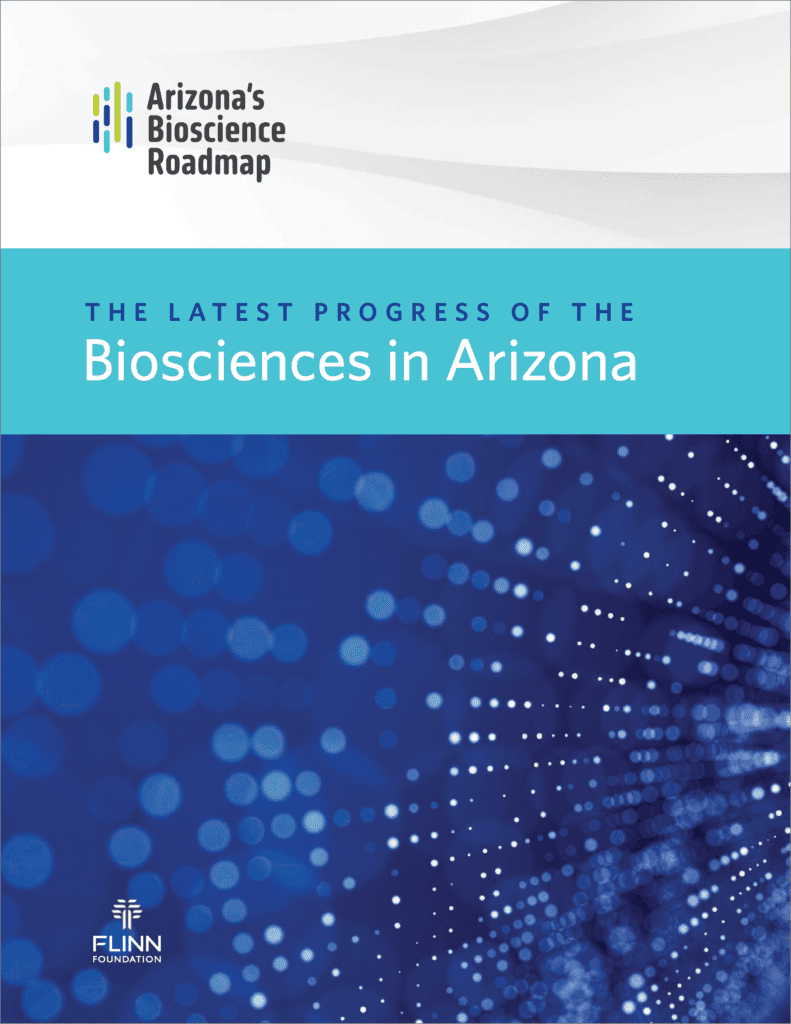
The event was hosted by Jennifer Barton, chair of Arizona’s Bioscience Roadmap Steering Committee and interim vice provost for health programs at the University of Arizona. It included the release of the new Progress Report, which is produced annually by the Flinn Foundation.
The new report includes a call to action for people to become involved and find their place in Arizona’s growing bioscience ecosystem by attending convenings, visiting incubators, and connecting with new groups. Also included is a summary of the state’s major developments over the past year and a review of the latest performance metrics.
The new Arizona’s Bioscience Roadmap, which was unveiled in September 2025 with in-person events in Flagstaff, Phoenix, and Tucson, remains the longest-running statewide bioscience strategic plan in the nation.
The Steering Committee, with Barton as chair and Wexford Science and Technology’s Kyle Jardine as vice chair, includes more than 80 leaders from the public and private sectors in science, health care, business, academia, and policy. The committee advances Arizona’s bioscience ecosystem and the Roadmap’s five goals – one of which is to amplify the collaborative gene.
About the Flinn Foundation
The Flinn Foundation is a Phoenix-based privately endowed, philanthropic grantmaking organization established in 1965 by Dr. Robert S. and Irene P. Flinn that awards grants and operates programs in four areas: the biosciences, the Flinn Scholars, arts and culture, and the Arizona Center for Civic Leadership. The foundation’s mission is to improve the quality of life in Arizona to benefit future generations.
Learn more:
Progress Report
Event Video
Arizona’s Bioscience Roadmap