Special for the Flinn Foundation
A team from Childsplay Theatre and Arizona State University is among 10 teams nationwide to receive a grant to research the connection between arts and wellness.
The Renée Fleming Neuroarts Investigator Awards recognize teams of artists and early-career researchers exploring the impact of, among other things, music, movement, storytelling, and filmmaking on health outcomes.

Jenny Millinger 
Neelima Wagley, Ph.D. 
Lauren van Huisstede
The Arizona Community Neuroarts Coalition is part of the growing national movement born out of the NeuroArts Blueprint Initiative, a partnership between The Johns Hopkins University and The Aspen Institute.
In Arizona and around the country, local coalitions are harnessing arts and aesthetic experiences to improve health, well-being, social cohesion, and community resilience.
Childsplay Associate Artistic Director Jenny Millinger, ASU Assistant Professor Neelima Wagley, and ASU Assistant Research Professor Lauren van Huisstede will receive a grant of $25,000 to support their interdisciplinary research project. The results will contribute to the growing body of scientific evidence underpinning the field of neuroarts.
We asked them to help us understand their work. Responses are written jointly, unless otherwise noted:
How do you define neuroarts?
Neuroarts sits at the intersection of neuroscience and the arts. It asks how arts-based experiences shape the body, brain, and behavior—and how we can use that knowledge to support human well-being.
For Jenny as an artist, this means exploring the neurological underpinnings of how young people respond to the art she creates and exploring how drama might serve as a support and catalyst for young people as they grow.
For Neelima as a neuroscientist, this means exploring a new and influential perspective of learning and development that she had never considered in her research. For Lauren as a child development researcher and artist it means investigating, with new scientific tools, what she has long suspected from both research and experience: how children learn is deeply tied to what they feel and do.
Tell us about the work that was funded. What’s it called? Why do you think it’s important? Why preschoolers?
Our project examines story drama, a storytime approach in which children don’t just listen to a book, they physically act it out by taking on the roles and emotions of the characters. We’re studying whether this kind of active, embodied storytelling supports socioemotional learning by engaging brain systems involved in emotion and movement.
To do that, we’re using a portable brain-imaging tool to measure neural activity during reading, reenactment, and story retelling.
We’re building on our earlier research that found children who experience stories through drama better understand and remember characters’ emotional journeys and story events.
We think we understand why: theories of embodied cognition suggest that when children move and physically embody emotions and key plot points, they activate the same brain regions involved in feeling and experiencing those events. This activation helps deepen their understanding and strengthens how they remember the story.
What we haven’t been able to do until now is test this theory directly in this context. This study lets us ask, “What’s happening neurologically when children are experiencing a story instead of just listening to it?”
This study will help us understand not only how story drama affects the brain but also contributes to building a stronger evidence base for arts-based approaches in early childhood education.
Socioemotional skills are foundational for children’s well-being and success in school and in life. Preschool is an important window for growth for socioemotional competence, and many neurodiverse preschoolers face additional challenges in developing these skills.
We hope this work can help make the case for story drama as a research-informed, effective practice that is widely implemented in early childhood classrooms.
How did a researcher and an artist meet? How did you come up with the idea to look into a possible link between the well-being of children and dramatic performance?
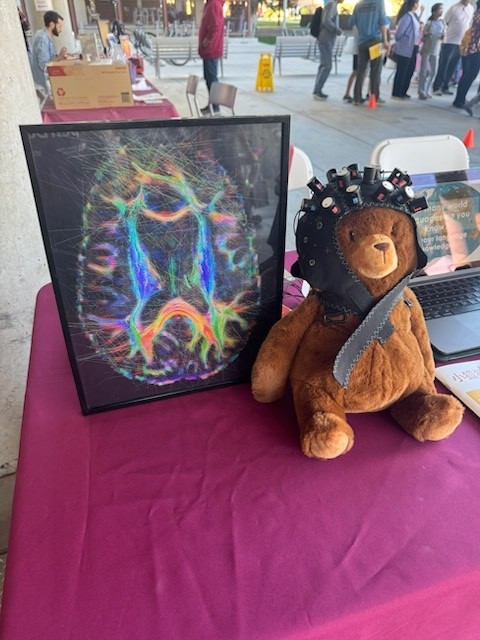
Jenny has been wanting to put a “space helmet” on kids during drama time since she first heard about fMRI technology a decade ago.
Jenny and Lauren, along with a team at Childsplay and ASU, have spent more than a decade researching how drama supports young people’s learning, wellness, and social-emotional development.
Our partnership, Literacy@Play, has explored drama-based instruction in elementary school classrooms, dual-language classrooms, early childhood settings, and, most recently, in inclusion classrooms. Our research to date has relied on more traditional measures: standardized assessments, story retelling protocols, video observations, etc. And while we can see and measure children’s success and growth when they participate in drama-based activities and theorize about the role of embodied cognition in learning, we still don’t fully understand why it works.
We developed this proposal for neuroarts with a specific and narrow focus on early childhood and drama-based storytimes. Once we determine whether the technology is adaptable to classroom environments and what brain areas are implicated in experiencing stories through drama, we hope to apply it across a wider range of theater experiences. Ultimately, we hope to understand how the arts shape learning and development in ways that we can see and measure.
How will you go about your work? What will success look like?
We will invite young people to come to Childsplay and/or their regular elementary school classroom and participate in storytimes. Some of those storytimes will be “regular” readings of a picture book; others will be story drama versions of the same book.
We will measure brain activity in both conditions, allowing us to compare how the same child responds to each type of experience. We’ll also look at how children retell the story afterward to understand differences in their comprehension and brain activation.
Since this is the first time the technology will be used in an active drama classroom, our initial measure of success will be learning how to keep the helmet attached and activated as children roam around pretending to be kittens or dinosaurs! Once we have the technical elements worked out, we will look for signals in the temporal and frontal areas of the brain, to learn whether playing through a story as a character generates differences in brain activity compared to passive listening experiences.
We hope to recruit preschool-aged children with diverse neurodevelopmental profiles to understand how drama-based experiences support the development of social-emotional knowledge for all young people.
How do you see health and arts intersecting to help the broader community?
Millinger: There’s a play called “The Yellow Boat” that is the essence of how Childsplay makes art. It was written by our founding artistic director, David Saar, about his son Benjamin, who was a young artist. Benjamin was the first pediatric AIDS patient in Arizona. It changed the field of theater for young audiences through both its content and its phenomenal artistry.
At its core is the story of how Benjamin and his parents expressed themselves through drawing, song, and storytelling. This ranged from diagnostics (Benjamin drew pictures of his belly to help his medical team identify the source of a “red hurt”) to child and parents helping each other process the dawning knowledge of Benjamin’s death through a song (from mom) and artwork (from Benjamin) in which three boats set out to sea, but only two return to harbor.
It is stunningly beautiful. And to me, it underscores the incredibly deep connection between ourselves as artists and ourselves as beings that experience physical and emotional pain.
Art can provide patients, caregivers, and medical teams with incredible insight into the human condition, into both the actual physical stresses of disease and the emotional experience of “health” writ large. And it can heal in ways that support and possibly even surpass traditional medical interventions.
When we stop viewing art as “extra” and instead view it as essential to health and well-being, we will see a transformation in how our community thinks about, experiences, and responds to medical complexities. And it will make us healthier and more joyful in the process.
van Huisstede: One of the core purposes of art is to evoke emotional responses and connect us through those emotions. It helps us step into experiences and journeys we may never have had ourselves in a safe and meaningful way.
In this way, art can foster empathy and deepen our capacity to care for others. Because of that, art can also play this powerful role in reducing stigma, particularly around marginalized or misunderstood health conditions, including mental health. It can move us toward a more equitable, compassionate world that prioritizes the well-being of all.
And when we intentionally integrate art for learning (like with story drama), it becomes an incredibly powerful tool, opening up pathways for understanding, empathy, and connection.