Deadline to apply for a 2027 Flinn Scholarship is Tuesday, Oct. 13.
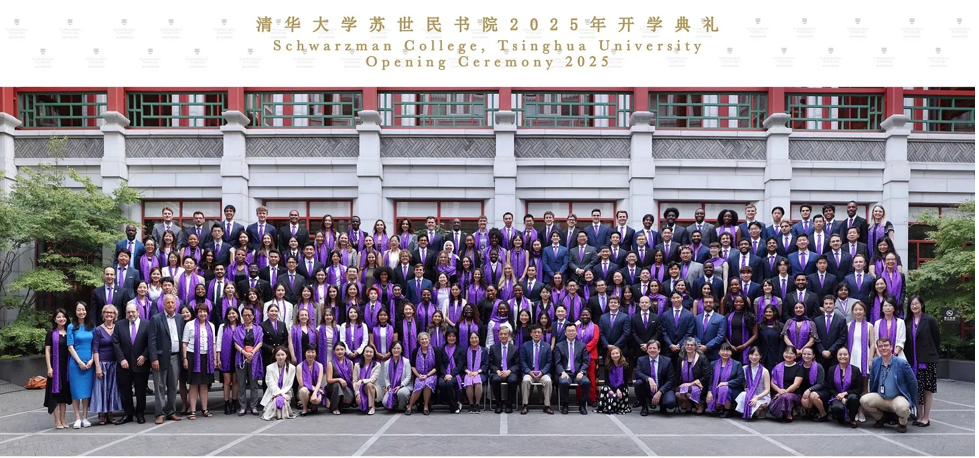
How was your experience as a Schwarzman Scholar?
I started as a Flinn Scholar in the fall of 2019, infamously the academic year COVID-19 rendered classes remote and ended the long-running China trip. However, this past year, my journey took a surprising detour to Beijing, where I completed a master’s program at Tsinghua University as the second Schwarzman Scholar to come from Arizona State University.
Serendipitously, it’s also where Chad Futrell, the former organizer of the Flinn China trip, is now assistant dean. He spoke fondly of the Scholars he worked with every summer and was thrilled to see a Flinn in the program.
Schwarzman Scholars is a highly selective, fully funded master’s program in global affairs. The program brings together around 150 students each year from more than 40 countries. Life at the college was incredible in and of itself. The building is beautiful and nestled in the middle of the broader Tsinghua campus. All 150 scholars live together, eat together, and take core classes together in the same building.
Merely walking into the hallway yields both fascinating and ridiculously nerdy conversations ranging from the future of AI, geopolitics, or philosophical and literature debates. This is helped by the unique diversity of student backgrounds, which ranges extensively, from lawyers to climate activists to former analysts on Wall Street.
As someone who was the first in my family to go to college, this expanded my network and understanding of how various sectors are deeply interconnected. From this, I learned that building a professional network is about more than just knowing lots of people. Far more important than the size of your network is knowing how to bring people, with their unique expertise, interests, and talents, together to truly collaborate towards big goals.
What was the highlight of the experience?
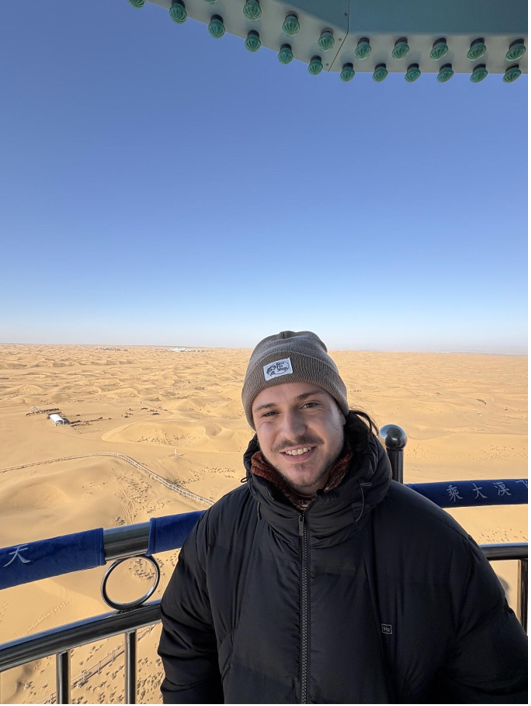
One of my favorite experiences early in the program was Deep Dive, a week-long trip to a small rural province in China to see how policy is implemented at the local level.
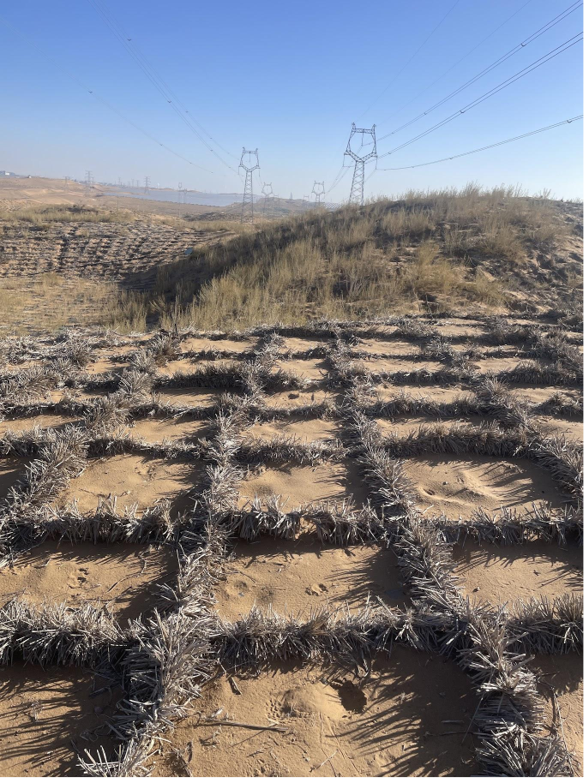
My group traveled to Ningxia in the northwest, where we learned about the government’s efforts to build renewable-energy capacity and combat desertification, the process by which fertile lands slowly turn into non-arable desert. At the edge of the desert, we watched workers place straw into checkerboard grids that hold sand in place long enough for grass and other vegetation to take root. Over time, this process can turn desert land into grazing areas, farmland, and even vineyards that produce Chinese wine. Desertification can lead to an unstable food and water supply, and it’s happening globally.
Solving these complex problems requires interdisciplinary solutions, and so it was meaningful to meet the university lab tasked with the challenge; whose lab director was also given a position in the government to directly implement the team’s findings in policy. It reminded me of the urban planning labs at ASU, which worked closely with the city of Phoenix.
It was also fascinating to learn about the political structure of China with politicians consisting of Ph.D.’s and engineers. Policy is largely driven by state and local level innovation where officials compete tournament style for the best outcomes like GDP growth, pollution levels, infrastructure, etc. I strongly recommend the book, “Breakneck,” by Dan Wang if any of this piques your curiosity.
However, more than anything, I felt proud to be a Sun Devil in these spaces largely dominated by Ivy-educated alumni. Futrell told me that the Flinn students he led every summer were some of the brightest and most intellectually curious groups he had worked with. It only surprised him that there were not more of us at Schwarzman College. So I encourage any alumni under 30 to apply!
Where are you now, and what excites you most about your work?
I work for Analogy Group, a startup that builds research systems for public-affairs organizations. We help progressive and not-for-profit clients organize complicated information, map relationships, and answer difficult research questions. This might seem like a pivot from my previous work. I started out my career working as a gun violence prevention and education advocate, worked in state and local politics, and even lived in Germany for a year as an organizer for the European Union elections.
However, the thread that ties my work experience and interests together is my intense and unwavering desire to create meaningful change. I consider myself a change opportunist, and where I see the ability to create the most impact, I go. And this philosophy has led me to many surprising places, both locally and globally. If anything, my diverse experiences have led me to develop a unique perspective, an invaluable asset for my own personal development, and for any type of job I might take on in the future. So, in my work, I am certainly most excited about using the things I’ve learned through my global experiences to maximize the impact of my work in building a better future.
How did being a Flinn Scholar shape your academic and/or career path?
Within the Flinn community, there is no such thing as a “typical Scholar.” Even within my own class, my cohort studied everything from medicine to agriculture to philosophy to animation. No two Scholars had the same academic profile, or professional interests. And yet, we share everything in common. Everything important, at least. We have similar aspirations, similar work ethics, and similar desires to change the world. Beyond college, I’ve watched many, perhaps even most, people in my cohort completely pivot their personal and career goals more times than I can count.
Being a Flinn Scholar shaped me by teaching me that change—changing your mind, changing your dreams, changing your life path—isn’t just “okay,” it’s a necessary part of life. I am proud to be changing and evolving alongside my fellow Scholars, many of whom I am still regularly in touch with.
Is there a project, achievement, or experience you’re especially proud of?
I am most grateful for the ability to take on risk and expand my understanding of the world beyond the classroom. As a Scholar, I was able to take a leave of absence and spend time with my family in Lebanon. There, I volunteered with UNICEF as a teacher, worked with a LGBT nonprofit in Beirut, and most importantly, spent time in my village.
In April, it was bombarded and bulldozed amid Israel’s land incursion into Lebanon as the various conflicts in the Middle East persist. The support and flexibility of the Flinn Scholarship enabled me to visit my village one last time, and for that I am very grateful.
I also spent a year in Germany as a Congress Bundestag Fellow, studied abroad in Morocco, India, and Greece, and attended a conference in Brazil. The Flinn Scholarship supported me through countless personal turmoil, academic adventures, and unusual professional pivots. I reflect on these experiences fondly, and I would never have been able to attain my goals and grow in the way I have without the Foundation.
How do you stay connected with the Flinn community today?
I am still close to my cohort. I visited a fellow cohort member in Bangkok last November.
Post-graduation, Flinn has shifted from being a primarily academic community to a community I am confident I will lean on for the rest of my life. I consider many people in my cohort as close personal friends and professional colleagues. Even though we are spread out across Arizona and the world, we find ways to stay connected. I’ve reached out to older Flinns for career advice. And just this summer, I’ve been volunteering on a local political campaign alongside another member of my 2019 Flinn class. I aim to continue fostering these connections and giving back to my Flinn community in whatever way I can.