*This article first appeared in the Winter 2025 issue of Arizona Physician magazine, a publication of the Maricopa County Medical Society.
By Brian Powell
Flinn Foundation
The Arizona Cardinals and the state’s ascension in the biosciences over the past two decades are forever linked.
The football team had received voter approval for a new retractable-roof stadium, and the city of Phoenix had an available 30-acre downtown site near 7th Street and Fillmore Avenue just north of the professional sports venues that were starting to revitalize the area.
But by early 2002, a potential deal for the stadium to be built on that land fell apart.
By the end of that year, the Flinn Foundation was announcing the launch of Arizona’s Bioscience Roadmap, a long-term strategic plan that contributed to a far different use for Phoenix’s downtown land — a bioscience hub that’s been a catalyst for more than 20 years of sustained sector growth.
Read, download a copy of Arizona’s Bioscience Roadmap.
Today’s Phoenix Bioscience Core is home to the private research institute TGen — started with support from Flinn and other private and public partners — the University of Arizona College of Medicine-Phoenix, Wexford Science and Technology’s 850PBC building, Northern Arizona University, Bioscience High School, and is the future site of Arizona State University Health and its medical school — The John Shufeldt School of Medicine and Medical Engineering.
New bioscience hubs have emerged at Park Central in midtown Phoenix — which features the Creighton University Health Sciences Campus and WearTech Applied Research Center — as well as the planned Discovery Oasis on Mayo Clinic’s North Phoenix campus adjacent to the ASU Health Futures Center.
An October report states the 10-year partnership between the University of Arizona and Banner Health, which includes the Banner University Medical Center-Phoenix and Banner Alzheimer’s Institutes, has had a $59 billion impact and helped keep more than 1,100 physicians in state.
Within this context of expansion, the Flinn Foundation unveiled the third iteration of Arizona’s Bioscience Roadmap in September 2025 with a vision to become a nationally recognized, rising bioscience leader by 2030 with a skilled talent base, world-class research, and dynamic industry growth.

Dr. Alpa Shah, a Flinn Foundation board member, board-certified practicing pulmonary and critical care physician, and HonorHealth board member and past chief of staff, said the Flinn board felt that renewing the Roadmap was crucial in keeping Arizona at the forefront of innovation.
“The bioscience sector has been evolving rapidly with breakthroughs in precision medicine and AI-driven diagnostics,” Shah said. “The previous Roadmap laid a strong foundation in growing Arizona bioscience jobs and attracting significant funding and investments, and we felt extending the Roadmap ensures we build on that momentum and can adapt to new challenges.”
A historical link
The 1937 Maricopa County Medical Society board president was Dr. Robert Flinn, a young cardiologist from Prescott and a Harvard Medical School graduate who nearly three decades later would establish the Flinn Foundation together with his wife, Irene.

The Foundation’s first grant in 1965 was awarded to St. Joseph’s Hospital in Phoenix for five cardiac-arrest carts and two EKG units. St. Joseph’s, where Flinn led the cardiology and electrocardiology departments and served as chief of medical staff, received many of the Foundation’s early grants as the physician sought out the latest in medical technology and innovation.
Described as a futurist, Flinn was also instrumental in creating the University of Arizona College of Medicine in Tucson — the state’s first medical school.
Over the past 60 years, Flinn’s board of directors has consistently included physicians, including the current chair, Dr. Eric Reiman, a renowned Alzheimer’s disease researcher.
The vision for 2030
The new Bioscience Roadmap provides five goals for Arizona to improve health outcomes while growing its economy with well-paying jobs. The plan was commissioned by the Flinn Foundation and developed by California-based SRI International following more than a year of interviews, focus groups, and research.
The five overarching goals identified to establish the state as a nationally recognized leader are:
- Amplify the collaborate gene.
- Accelerate research into impact.
- Elevate Arizona’s startup ecosystem.
- Strengthen talent and career pathways.
- Tell Arizona’s bioscience story.
Strategies, more details in the Bioscience Roadmap executive summary.
More than 144,000 people are employed in bioscience companies and hospitals in Arizona. Medical device manufacturing, neuroscience, oncology, and precision medicine are among the areas of particular excellence and promise in Arizona, the Roadmap states.
More data on Arizona’s bioscience ecosystem in the latest Bioscience Progress Report.
The state had a job growth rate of 8.1% in the biosciences between 2020-2023, outpacing the national rate, and record highs last year in National Institutes of Health funding and bioscience research and development.
Physician-driven research
Dr. Brandon Fox is a sixth-year neurosurgery resident at Barrow Neurological Institute and a 2023 Flinn Foundation Translational Seed Grants Program awardee. The funds helped his team develop a novel neurostimulator device to monitor comatose patients without applying physical stimulation, while also eliminating the variability found in a sternal rub or other technique.
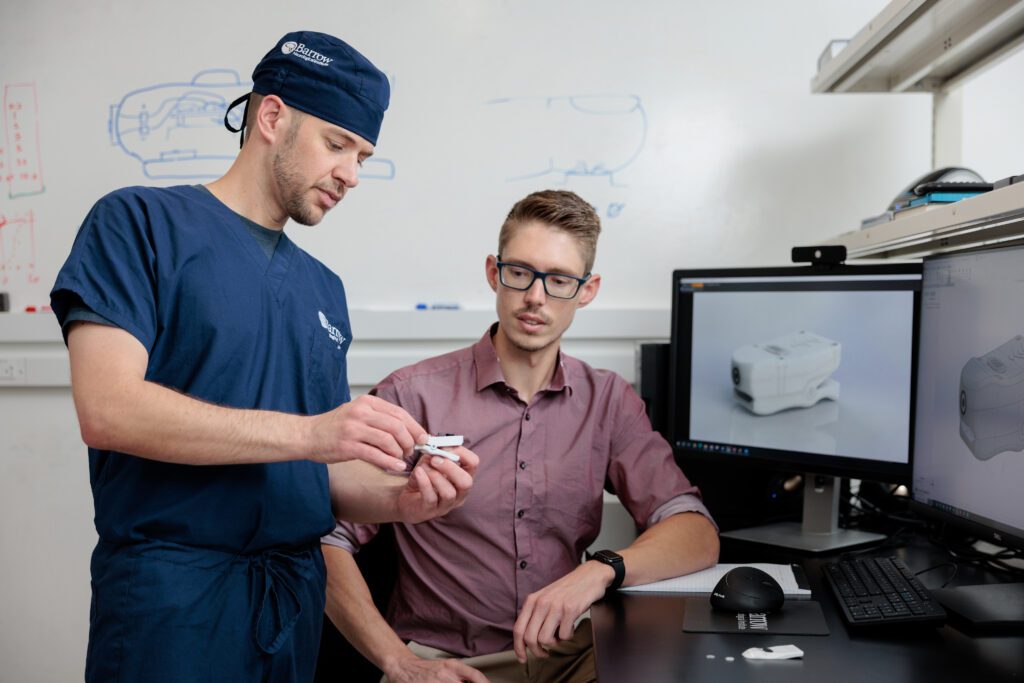
“Our goal is to do something that would solve both of those problems. It would standardize the pain stimulus and make it so it never injures patients,” Fox said. “It’s really a pretty simple problem but it had never been addressed, and no one had ever tried alternatives.”
All about the Flinn Foundation’s Translational Seed Grants Program
Fox’s team at BNI’s Thurston Innovation Center, which also received a research grant from the state-backed Partnership for Economic Innovation, devised a way to monitor patients with an electrical stimulator that delivers a standardized, constant-current stimulus. Clinical trials were first completed at BNI. The next step is using the device in clinical trials at other locations before taking it to market.
Mary O’Reilly, Flinn Foundation vice president, bioscience research programs, oversees Flinn’s seed grants program, which awards $100,000 a year to 10 Arizona-based research teams. She said these opportunities to bridge clinical practice with innovation can strengthen partnerships and accelerate commercialization, leading to the creation of new products and services that benefit human health.
“Medical innovation requires physician input,” O’Reilly said. “This path follows in the footsteps of our founder, Dr. Flinn, who was a cardiologist and innovator himself.”
A home for physicians
The Roadmap offers many paths for physicians, researchers, entrepreneurs, educators, investors, students, and policymakers to become involved.
Clinicians can participate in research leading to new diagnostics, devices, and health care delivery options. And those involved in policy and advocacy roles can speak to the state’s successes, and champion favorable policies related to the health-care workforce and additional funding for translational research. Physicians leading key organizations have long served as members of Arizona’s Bioscience Roadmap Steering Committee, a group of more than 100 bioscience leaders from the private and public sectors that oversee the plan.
“As a physician, I believe we are fostering an environment that encourages collaboration and innovation. We are recruiting the best minds in science to our local environment as we attract more bioscience companies and scientists to our research institutions,” Shah said. “Ultimately, we will enhance patient care and health outcomes for all Arizonans, whether through preventative care, diagnostics, or therapeutics.”
Local health care providers and practitioners, academics, industry leaders, and other stakeholders can all find their place in the new Arizona’s Bioscience Roadmap, Shah added.
As for the Arizona Cardinals, they eventually found their home in the cotton fields of Glendale, while the biosciences took root in downtown Phoenix and beyond, providing energy, excitement and hope for the region on more than just Sunday afternoons.