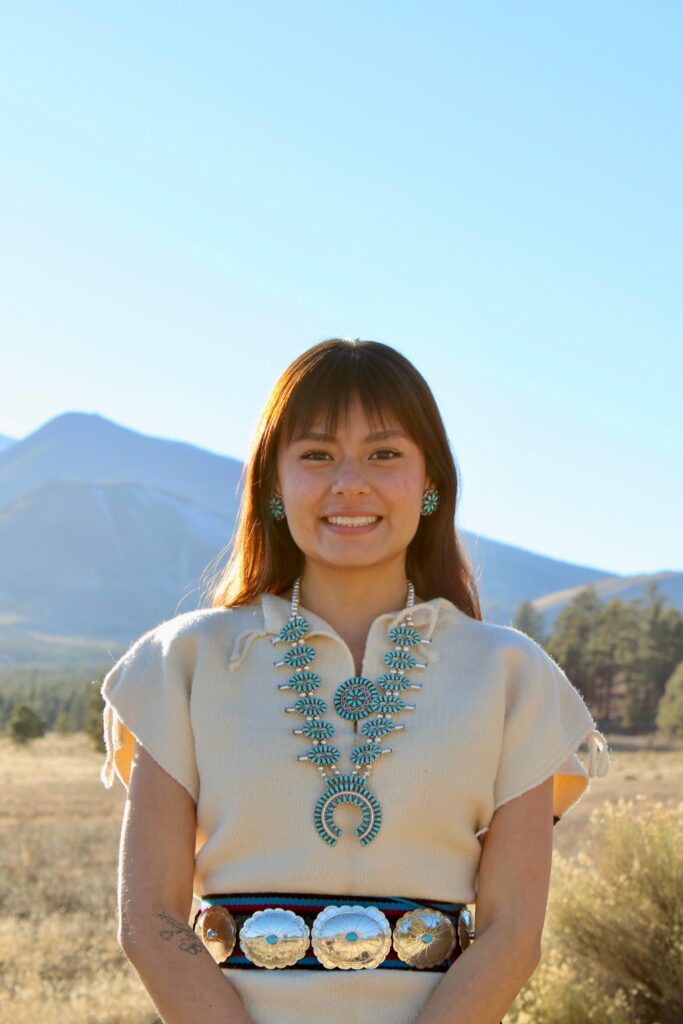
Kaya Dickson (Class of 2022) is part of a new generation of leaders shaping change as a founding member of the Navajo Nation Youth Advisory Council.
She is part of an inaugural group working to ensure that young people are not only heard, but actively involved in decision-making that affects their communities.
In this Q&A, she reflects on her journey, the responsibility of building something from the ground up, and the power of youth leadership rooted in community and culture.
Will you briefly introduce yourself, including your academic interests and any areas you’re especially passionate about?
Yá’át’ééh shik’ei dóó shidiné’é, my name is Kaya Dickson, Yé’ii Dine’é Táchii’nii nishłi, Tsé Deeshgíízhíníí bashishchiin, Naakaiiłbáhí dashicheii, Ma’ii Deeshgíízhíníí dashnali. I am originally from Kaibeto and grew up in Page. I am a recent graduate from Northern Arizona University with a Bachelor of Science in Sociology and a minor in criminology and Criminal Justice. I am passionate about creating pathways for our Indigenous communities through research and advocacy, raising awareness of issues that deeply affect our relatives and Mother Earth. Our knowledge of and connection to the land is foundational. It shapes our health, education, and the way we live each day.
You are a founding member of the Navajo Nation Youth Advisory Council, representing the Western Navajo Agency. What motivated you to get involved, and what does it mean to you to be part of building something from the beginning?
I’ve seen how powerful youth are today, and how strong our voices are when we come together as a collective. Everyone who was selected to serve on the council embodies our teachings of K’é and Hózhó, and we all want to see action in our communities. With the obstacles we face as Indigenous people, we need to prioritize thinking as a collective and looking out for one another. I am so honored to be part of an organization that is Indigenous-led and youth-led; we are the incoming and upcoming leaders who will act!
(Hózhó refers to walking in beauty, which means maintaining balance and harmony between your own being and the surrounding beings, and welcoming and sharing blessings.)
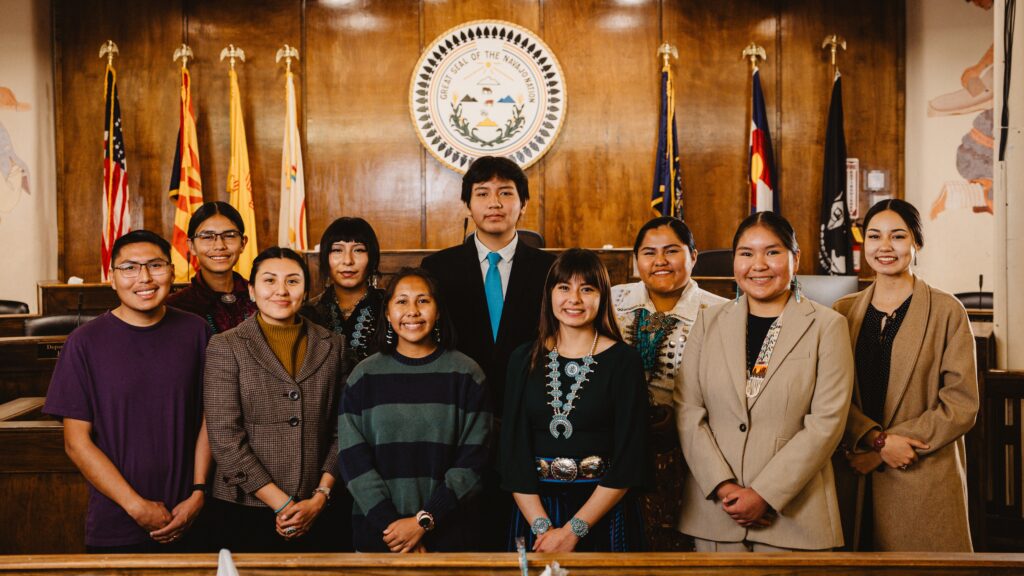
Tell us about the Council’s first meeting and what you are most hoping it will accomplish?
The first meeting was very inspiring and exciting. We were able to talk with a few Navajo Nation Council delegates and hear their stories, which encouraged us to start taking on the responsibility of creating change and representation in the community. They shared their ambitions for their life journeys and how hard they worked to establish our youth council, because our youth voices matter. We need to hold on tight to our language and culture.
I hope to use my platform to advocate for our unsheltered relatives in border towns and to preserve our sacred sites from economic and recreational development, such as the San Francisco Peaks (Dook’o’oosłííd). The desecration of our sacred sites threatens our preservation of culture, prayer, language, ceremony. By exploiting our lands, we’re disrupting the balance between ourselves and the deities. The land is one of the foundations of our identity.
Extending K’é means including everyone, and sharing that responsibility of caring for one another, no matter who it is. Through my current work with the Community Assistance Teams of Flagstaff, we offer a shower bus unit along with clothing, food, camping supplies, and referrals to community resources. More than 56% of our unsheltered population in the Flagstaff area identify as Indigenous. I hope to share these projects with the youth council, bring these resources to those in need on the reservation, and continue educating others about the importance of protecting our sacred sites.
How has being a Flinn Scholar influenced your journey leading up to this moment?
Having the honor and platform of being a Flinn Scholar has given me the confidence to lead my community and work with like-minded peers. The Flinn Foundation has helped me understand that changes in our journey are necessary to grow and truly learn about ourselves and our environments.
Through the twists and turns in my academic journey, I have learned to welcome change and not be afraid of what the future holds. I seize every opportunity that comes my way, open myself to the lessons it offers, and hope to pass those lessons on to the younger generation. Especially as part of the small cohort of Indigenous scholars at the Flinn Foundation, the Foundation has helped me find my grounding and given me a platform to represent my community on the Navajo Nation and in Northern Arizona.
In what ways have your personal background and your university experience influenced how you approach leadership and service?
In Navajo culture, we are taught to carry our families, communities, and those who have journeyed onto the next world with us wherever we go in life. We are taught to hold ourselves strong, stand tall, introduce ourselves, and be kind. And as we walk our life paths, not only are our family and community with us, but also the entities that surround us. Ni’asdzáán shimá (Mother Earth), Yádiłhił shitaa’ (Father Sky), the trees, the birds, the water, and the mountains are all watching and guiding us.
I had a hard time my first year at university and felt alone while trying to navigate the college transition, especially as a first-generation and Indigenous student. But the more I turned to my family, my mentors, my friends, and especially my culture, the more I began planting the roots of a foundation to keep me going, and now I can say I’m ready to take anything head-on. I am connected to a network of Indigenous change-makers, and through prayer and ceremony at the fireplace, I find peace, harmony, and resilience. We all have a purpose and a calling, but that means going through hardships to make us stronger, taking accountability for ourselves, and building our resilience. It is a way of life.
What would you want a young person growing up on the Navajo Nation—or any student who feels underrepresented—to know about what’s possible for them?
In another fellowship I am part of with the Center for Native American Youth, at our convening, one of the guest speakers from the Navajo Nation mentioned, “Think globally, act locally.” Take all the knowledge you gain from every experience outside the home and bring it back to our communities to empower the next generation.
New people and environments help us grow and find ways to incorporate our Indigeneity into those spaces. Make yourself known and speak up. The barriers we face want us to give up, want us to back away. Our roots and community are what make us all the more powerful and resilient. To create impact and change, take time to know yourself and carry that confidence in every room you enter. Wear your regalia with confidence and speak your language with pride.
Our culture is rooted in K’é and Hózhó, which can be applied to everyday life and help you stand tall and confident in the face of the barriers we face in the real world. The sacrifices of our ancestors and the resilience that is embedded in culture and community lead you to this very moment.
More Scholars news
Ariana Rahman (Class of 2024) named Goldwater Scholar.
Zahrah Ralph (Class of 2024) chosen for Pattie Grace Smith Fellowship.